
Experienced Workers Award - NVQ3

For experienced electrical workers who have spent years developing their skills on site but don't yet hold a recognised Level 3 competency qualification, gaining an ECS Gold Card can sometimes feel unnecessarily complicated.
The good news is that experienced workers don't necessarily have to start again with an apprenticeship or repeat training covering skills they already use every day.
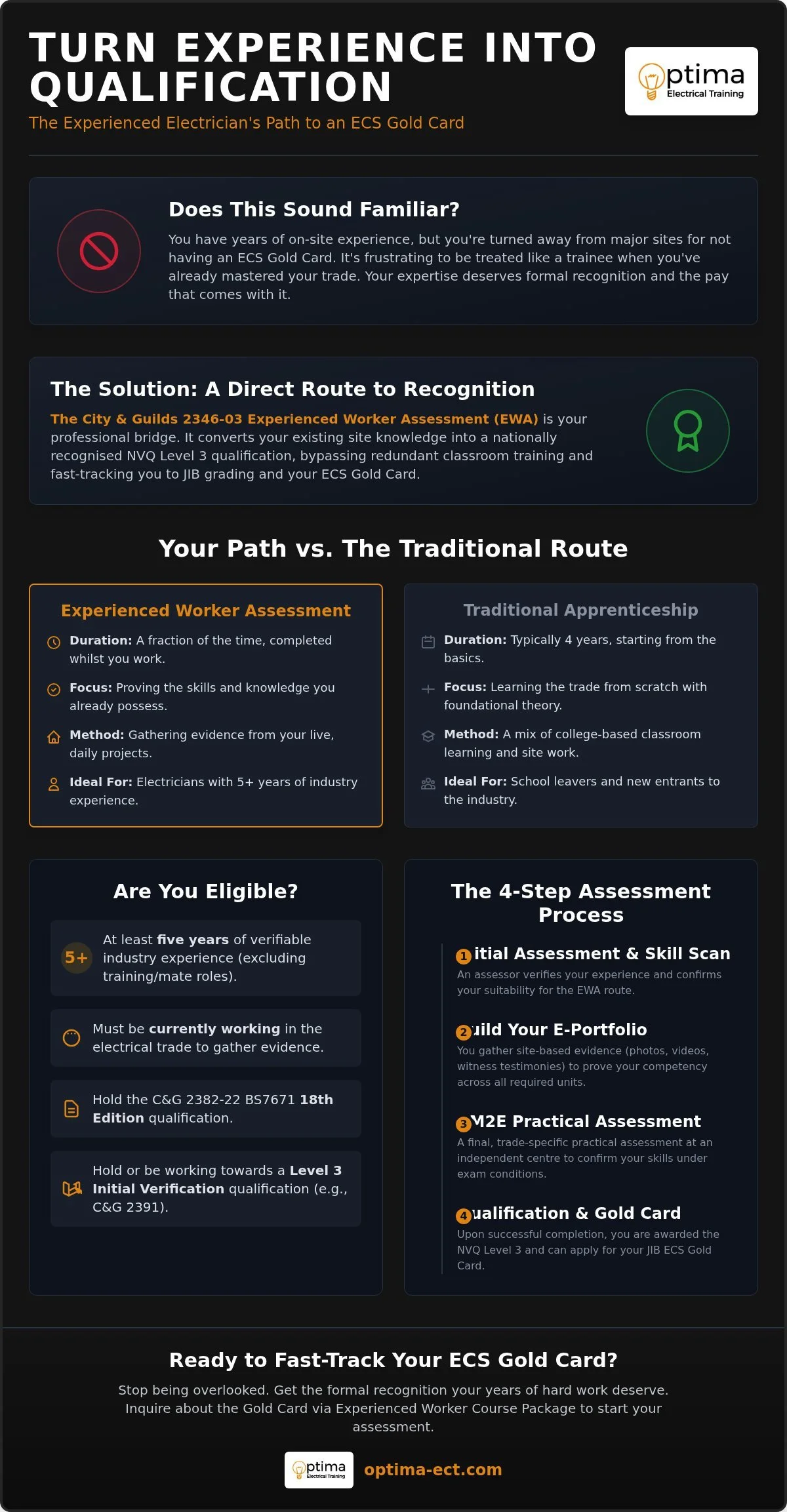
The Experienced Worker Assessment (EWA) provides a route for eligible electricians to demonstrate their existing occupational competence and work towards the qualifications needed for recognition as a qualified electrician.
But who is the route designed for, what does it involve, and how does it lead towards an ECS Gold Card?
What is the Experienced Worker Assessment?
The Experienced Worker Assessment is designed for people who have substantial experience working within the electrical industry but have not previously completed an apprenticeship or equivalent Level 3 competency qualification.
Rather than retraining from the beginning, experienced workers are assessed against an industry-recognised standard, demonstrating the knowledge and practical competence they have developed through their work.
For eligible installation electricians, one of the available qualifications is the City & Guilds Level 3 Electrotechnical Experienced Worker Qualification (2346-03).
This makes it very different from an entry-level electrical course. The emphasis is not simply on learning electrical theory in a classroom; candidates must be able to provide evidence that they are already carrying out electrical work competently in a real working environment.
Who is the Experienced Worker Route for?
This pathway is specifically intended for established electrical workers. Eligibility is therefore important. The Experienced Worker Assessment should not be seen as a shortcut for somebody who has recently completed their classroom qualifications but has only limited practical experience.
Before beginning the process, candidates undertake a Skills Scan to assess their existing qualifications, knowledge and experience against the requirements of the Experienced Worker Standard. This helps establish whether the candidate has sufficient breadth and depth of experience to follow the route and identifies any areas that may need to be addressed.
Candidates need significant experience within the electrotechnical industry and must be able to demonstrate competence across the range of activities required by the qualification. For someone who is relatively new to electrical work, the standard training and NVQ route is likely to be more appropriate.
What Experience Will You Need to Demonstrate?
Being experienced doesn't simply mean having worked around electrical installations for a certain number of years.
The assessment is about occupational competence.
Candidates need to demonstrate that they can carry out the work expected of a qualified electrician safely and correctly. Depending on the qualification and work being assessed, evidence may include activities such as:
planning and preparing electrical installation work;
installing wiring systems and associated equipment;
terminating and connecting conductors;
applying appropriate health and safety procedures;
carrying out inspection, testing and commissioning;
diagnosing and correcting faults; and
demonstrating an understanding of relevant regulations and industry requirements.
This breadth is important.
Someone who has spent many years carrying out only a very narrow range of electrical tasks may have substantial industry experience but could still have gaps against the Experienced Worker Standard.
The initial Skills Scan is therefore an important part of the process rather than simply an enrolment formality.
Turning Your Site Experience into an NVQ Level 3 Qualification
One of the major advantages of the Experienced Worker route is that much of the evidence can be gathered through the work you are already carrying out.
Candidates build a portfolio demonstrating their competence against the qualification requirements.
Evidence can include photographs and videos from site, documentation from jobs, witness testimony and discussions with an assessor.
This means that instead of attending lengthy periods of practical training to demonstrate skills you already possess, you are showing how those skills are applied in a genuine working environment.
However, candidates shouldn't underestimate the importance of collecting good-quality evidence.
A photograph of a completed installation, for example, may not tell an assessor very much about how the work was carried out. Evidence captured during different stages of an installation can be much more useful – showing containment, cable installation, connections and terminations before equipment is enclosed or covers are fitted. Getting into the habit of recording work as it progresses can make portfolio building considerably easier.
The Importance of Your Assessor
Your assessor plays an important role throughout the Experienced Worker Assessment.
Their job isn't simply to receive a large collection of photographs at the end of the programme. They will help identify the evidence required, assess whether it meets the relevant standards and highlight areas where further evidence may be necessary.
Professional discussions can also form part of the assessment process. These allow candidates to explain decisions they have made on site, demonstrate their technical understanding and provide additional evidence of competence that may not be obvious from photographs or documentation alone.
For experienced workers who haven't studied formally for many years, this can make the process feel considerably more relevant than traditional classroom-based learning. You're demonstrating what you know through the work you actually do.
What is the AM2E?
Completing the portfolio isn't the final stage.
Experienced Worker candidates must also successfully complete the AM2E assessment, administered by NET.
The AM2E is specifically designed for experienced workers and provides an independent assessment of practical occupational competence.
Candidates are assessed across key areas of electrical work, which can include installation activities, safe isolation, inspection and testing and fault diagnosis.
It is important to distinguish the AM2E from the standard AM2 undertaken through other qualification pathways. Both are rigorous assessments of practical competence, but the AM2E is specifically aligned with the Experienced Worker route.
For someone who has spent many years working in the trade, this is the point at which practical ability needs to be demonstrated under formal assessment conditions.
From Experienced Worker to ECS Gold Card
For many candidates, the ultimate objective is an ECS Installation Electrician Gold Card.
The ECS Gold Card is widely recognised across the UK electrotechnical industry and demonstrates that the holder meets the qualification and competency requirements for the occupation shown on the card.
This can be particularly important when working for larger contractors or on construction and infrastructure projects where appropriate ECS cards are required.
However, completing an electrical installation course alone isn't the same as becoming a qualified electrician. This distinction is important for anyone considering their training route.
Classroom qualifications provide essential technical knowledge and practical training, but occupational competence also needs to be demonstrated in the workplace. For experienced workers, the EWA provides a way of formally recognising competence that may have been developed over many years.
What if There Are Gaps in Your Experience?
One of the most common concerns among experienced candidates is discovering that their current work doesn't cover everything required by the qualification.
For example, somebody may be highly experienced in one particular sector but have limited exposure to another type of installation or activity required by the assessment. This doesn't necessarily mean the route isn't suitable.
The Skills Scan and assessment process can help identify those gaps early, giving candidates the opportunity to gain the necessary experience before attempting to complete the relevant elements.
What is important is that evidence must demonstrate genuine competence. An assessor cannot simply sign off an area because a candidate has worked in the industry for a long time.
Making Your Portfolio Easier to Manage
For working electricians, one of the biggest challenges isn't necessarily the electrical work – it's remembering to document it. Trying to recreate months of evidence at the end of an NVQ can make the process much harder than it needs to be.
A better approach is to make evidence collection part of your normal working routine. Take photographs at appropriate stages of a job, retain relevant documentation and make short notes about what you did and why. Always follow your employer's or client's rules regarding photography, confidentiality and site security.
Regular contact with your assessor is equally important. If you're unsure whether a particular job will provide suitable evidence, asking before or during the work can prevent missed opportunities.
Small amounts of consistent portfolio work are generally far easier to manage than allowing evidence to build up for months.
Is the Experienced Worker Route Right for You?
If you already have extensive electrical experience but don't hold the Level 3 competency qualification required for your intended ECS occupation, the Experienced Worker Assessment could provide an appropriate pathway.
It can be particularly valuable for people who entered the industry through a non-traditional route, learned their trade through employment or have older qualifications that don't provide the current occupational recognition they need.
But it is important to remember what the route is – and what it isn't.
It is a route for experienced electrical workers to prove existing competence, not a fast-track substitute for gaining electrical experience.
If you are only beginning your electrical career, completing technical qualifications and then gaining the workplace experience required for an NVQ Level 3 is generally the appropriate pathway.
Take the Next Step with Optima Electrical Training
At Optima Electrical Training, we support electricians at different stages of their journey towards recognised industry qualifications.
If you're an experienced electrical worker and are unsure whether the Experienced Worker route is appropriate, the first step is to review your existing qualifications and experience. Our team can help you understand the available pathway and whether your current work is likely to provide the breadth of evidence required.
For those who are eligible, the Experienced Worker Assessment can provide a valuable opportunity to turn years of practical experience into recognised qualifications – and take an important step towards achieving the ECS Gold Card
Thinking of Becoming a Qualified Electrician?
If you're interested in learning a skilled trade, why not train to become a certified professional?
At Optima, we provide comprehensive electrical training courses that equip you with the skills, qualifications, and confidence to work safely and legally in this vital industry.
Whether you’re just starting out or looking to expand your qualifications, our accredited training programmes will give you the knowledge, confidence, and credentials to meet new building standards and market demand.
✅ Hands-on training
✅ Industry-recognised certifications
✅ Expert instructors with real-world experience
✅ Courses tailored to upcoming regulations
Contact us today to embark on your training journey.
Contact us: Request Information
Email: info@optima-ect.com
Freephone +44 800 0371572