

How Long Does It Take to Become a Qualified Electrician in the UK? (2026 Guide)

Every year, thousands of adults consider retraining as electricians, attracted by strong earning potential, long-term job security and the opportunity to work in a practical, highly skilled profession. One of the first questions almost everyone asks is: "How long does it actually take to become a qualified electrician?"
The honest answer is that it depends on the route you choose, your previous experience and how quickly you gain practical site experience. School leavers completing apprenticeships will typically follow a different timeline to adult career changers undertaking intensive training while continuing to work.
The good news is that you don't necessarily have to wait until you're fully qualified before beginning your career. Many trainees secure employment as Electrical Labourers, Electrician's Mates or Electrical Improvers once they've completed their initial qualifications, allowing them to earn while working towards their NVQ Level 3 and ECS Gold Card.
This guide explains the typical timescales involved and what you can realistically expect during each stage of your journey.
There Isn't Just One Route Into the Industry
Unlike many professions, becoming an electrician isn't a single qualification followed by a licence to practise.
Instead, you'll complete a series of qualifications, practical assessments and workplace experience before achieving recognised industry status.
For most people, the two main routes are:
A traditional apprenticeship
An adult training programme followed by employment and completion of an NVQ
Both routes ultimately aim towards the same goal: becoming an industry-recognised electrician with an ECS Gold Card.
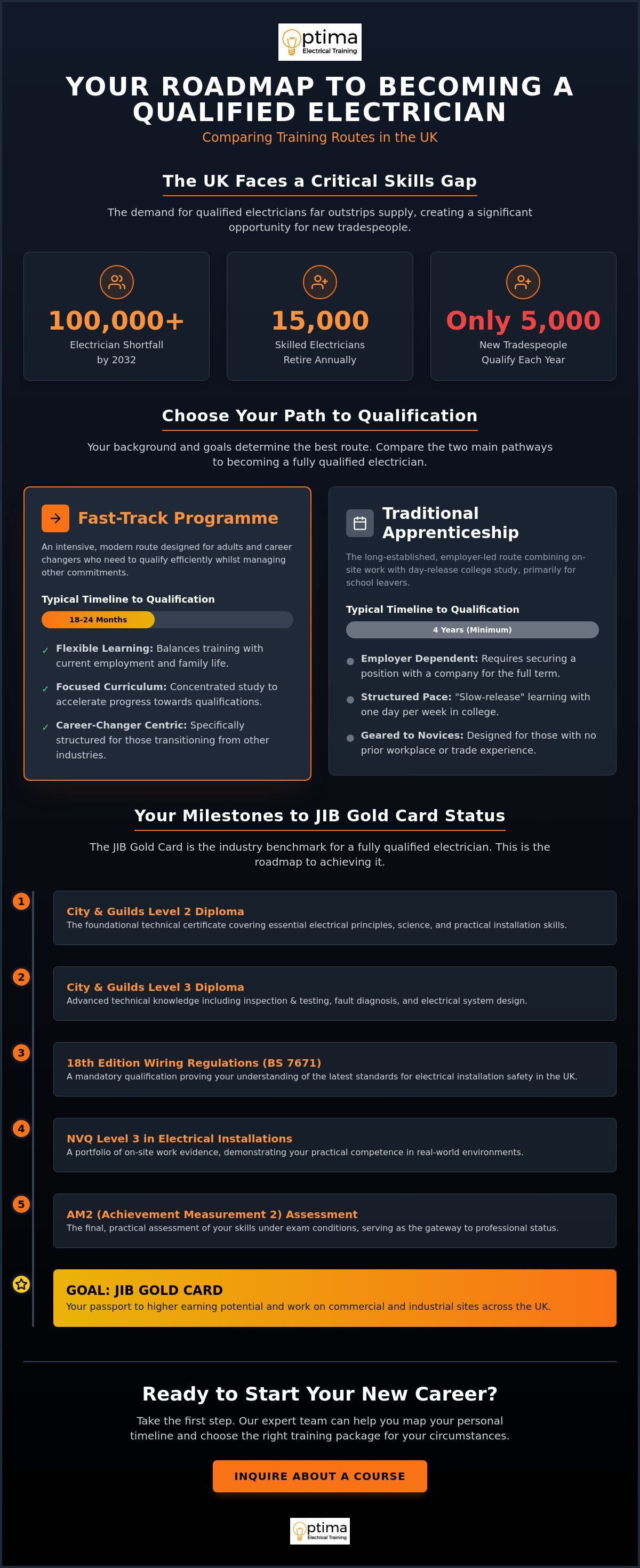
Route One: The Traditional Apprenticeship
Apprenticeships remain an excellent option for many school leavers.
Typically lasting around four years, they combine paid employment with day-release college study. During this period apprentices complete technical qualifications, gain workplace experience and eventually undertake the AM2 assessment.
The main advantage is that apprentices earn while they learn from day one. However, apprenticeships can be highly competitive, and many are aimed primarily at younger entrants beginning their careers.
For adults with mortgages, families or existing careers, living on an apprentice wage for several years is often unrealistic.
Route Two: Adult Training and Career Change
This is now one of the fastest-growing routes into the electrical industry.
Adult learners usually complete their classroom qualifications first before securing employment to complete their work-based NVQ.
Although every training provider structures courses differently, a typical pathway looks something like this:
City & Guilds Level 2 Diploma
Typical duration: 3–6 months
This introduces the fundamentals of electrical installation, including:
Health and safety
Electrical science
Installation methods
Basic wiring systems
Practical workshop skills
Many students complete Level 2 while continuing to work in another job.
18th Edition Wiring Regulations
Typical duration: 3–5 days
The BS 7671 18th Edition qualification is required by most employers and demonstrates an understanding of the UK's current wiring regulations.
Although relatively short, it is regarded as an essential qualification for anyone working within the industry.
City & Guilds Level 3 Diploma
Typical duration: 5–8 months
Level 3 develops the more advanced technical knowledge expected by employers, including:
Inspection and testing principles
Fault diagnosis
Electrical design
Scientific principles
Installation requirements
By this stage many learners begin applying for Electrical Mate or Electrical Improver positions.
When Can You Start Working?
One of the biggest misconceptions is that you cannot work in the industry until you're fully qualified.
In reality, many employers recruit trainees once they have completed their Level 2 or Level 3 qualifications.
Typical entry-level roles include:
Electrical Labourer
Electrician's Mate
Electrical Improver
Trainee Electrician
Working alongside experienced electricians allows learners to build practical experience while continuing towards full qualification.
This experience is also essential for completing the NVQ Level 3 portfolio required for ECS Gold Card status.
The NVQ Level 3
Unlike classroom qualifications, the NVQ Level 3 is completed in the workplace.
Rather than sitting written examinations, learners collect evidence demonstrating their competence across a wide range of electrical installation activities.
Typical evidence includes:
Installing containment systems
Cable installation
First and second fix work
Inspection and testing
Safe isolation procedures
Following current wiring regulations
The time required varies considerably because it depends upon the type of work available.
For someone employed full-time in electrical installation, many portfolios are completed within 6–18 months, although this can be shorter or longer depending on individual circumstances.
The AM2 Assessment
The final practical milestone is the AM2 Assessment.
This industry-recognised assessment tests whether candidates can safely complete electrical installation work to the required professional standard.
The assessment typically lasts around two to three days and covers:
Installation
Inspection and testing
Fault finding
Safe isolation
Health and safety
Successfully completing the AM2, alongside the required qualifications and NVQ, enables candidates to apply for an ECS Gold Card.
Typical Timescales
Although every learner progresses differently, the following provides a realistic guide.
Traditional Apprenticeship
Approximately 4 years
Adult Fast-Track Training
Level 2 Diploma – 3 to 6 months
18th Edition – 1 week
Level 3 Diploma – 5 to 8 months
Employment while completing NVQ
NVQ Level 3 – typically 6 to 18 months
AM2 Assessment – 2 to 3 days
Many adult learners therefore begin working within the industry well before they achieve full ECS Gold Card status.
Why the Industry Needs More Electricians
Demand for qualified electricians continues to grow.
The transition towards low-carbon technologies, electric vehicles, renewable energy systems, battery storage, smart buildings and increasing investment in infrastructure is creating sustained demand for skilled electrical workers.
At the same time, many experienced electricians are approaching retirement, creating additional pressure on the industry's workforce.
For people considering a career change, this combination of increasing demand and skills shortages makes electrical installation one of the UK's strongest long-term trades.
Can You Speed Up the Process?
While it's impossible to shortcut the practical experience needed to become a competent electrician, there are ways to progress more efficiently.
Many adult learners choose flexible or intensive training programmes that allow them to complete classroom qualifications more quickly than traditional day-release college courses.
Equally important is securing relevant site experience as early as possible. The sooner you begin working alongside qualified electricians, the sooner you'll be able to build the evidence required for your NVQ portfolio.
Choosing a training provider that also offers employability support, CV guidance and employer connections can therefore make a significant difference to the overall journey.
Final Thoughts
So, how long does it take to become a qualified electrician?
For school leavers completing apprenticeships, the answer is usually around four years.
For adult career changers, it's often possible to complete the classroom qualifications within around 12 months, secure employment soon afterwards and achieve full qualification through the NVQ and AM2 over the following year or so.
The important thing to remember is that becoming an electrician isn't simply about completing courses—it's about developing the practical skills, confidence and workplace experience that employers value.
With demand for skilled electricians expected to remain strong throughout the coming decade, investing the time to gain recognised qualifications could open the door to a rewarding and secure long-term career.
Thinking of Becoming a Qualified Electrician?
If you're interested in learning a skilled trade, why not train to become a certified professional?
At Optima, we provide comprehensive electrical training courses that equip you with the skills, qualifications, and confidence to work safely and legally in this vital industry.
Whether you’re just starting out or looking to expand your qualifications, our accredited training programmes will give you the knowledge, confidence, and credentials to meet new building standards and market demand.
✅ Hands-on training
✅ Industry-recognised certifications
✅ Expert instructors with real-world experience
✅ Courses tailored to upcoming regulations
Contact us today to embark on your training journey.
Contact us: Request Information
Email: info@optima-ect.com
Freephone +44 800 0371572